Register of the Rockies
The existence of hundreds of names in the Garden of the Gods has long been one of the best kept secrets of the Pikes Peak region. Covering the great sandstone rocks – to the height of the human reach – are the engraved names of some of the countless multitude who passed this way and who followed the centuries-old American custom of immortalizing their visits in stone. With chisel or knife or jagged rock they have carved into the naked sandstone surfaces not only their names, but also their points of departure and dates of arrival.
The Garden names are everywhere. There are names carved into the base of every major rock formation. There are some names high up on the rock walls, others half- hidden in the darkened recesses of the narrow clefts. There are names lining the passageway that leads to the top of South Gateway Rock, and a few names forever sealed inside the great cavern of its companion to the north. Throughout the park - from Balanced Rock in the southwest corner to White Rock near its eastern gateway - countless individuals have seen fit to register their Christian names, their initials, their distinguishing family names.
The earliest identifiable names in the Garden date back to the year 1858 and the beginnings of the great Pikes Peak Gold Rush. These names belonged to gold seekers I. L. Avery, William Hartley, Marshall M. Jewett, Fred Kockerhans, Augustus S. Voorhees and Andrew C. Wright.
To these early gold seekers the sandstone rocks at the base of Pikes Peak must have appeared as blank pages of gigantic proportions. Adam-like, they could not resist being among the first to carve their names into the virgin rock. None of the individuals so immortalized could have known that their signatures would survive a century and a quarter of exposure to the elements. None could have foreseen that the dates they recorded would one day be used as physical proof to mark their passage. But sign their names they did, dating them in the sandstone rocks. And in so doing, they initiated the practice that has long since turned this Garden of the Gods into the great Register of the Rockies.
Andrew C. (Jack) Wright
Location of Name
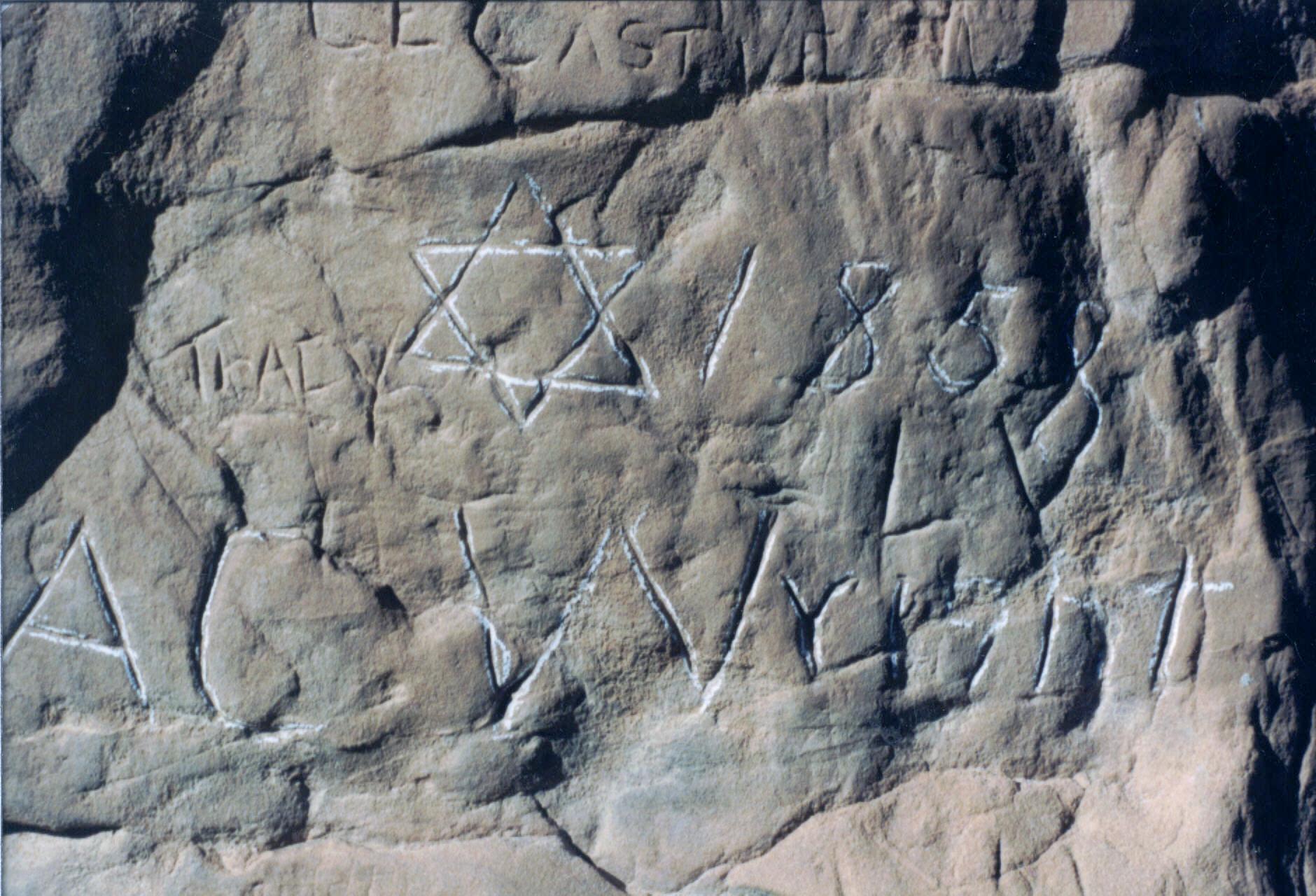
On the south side of Signature Rock, a 15'X20' boulder just to the southeast of North Gateway Rock. Above the name is a star composed of two equilateral triangles and the date 1858. The name is several inches to the right of the Wm. Hartley name.
Condition of Name
The last three letters in the name Wright have been partially obscured by the subsequent chipping of the rock.
Biography
Andrew C. Wright, better known by his nickname Jack, was born in New York City on 4 July 1835. While still quite young his parents moved him to Natrick, Mass. There he was educated and grew up. When twenty years of age he moved west to Kansas Territory, settling in the town of Lawrence in 1855.
Three years later Wright was among the thirty-five unmarried men who joined the gold seeking party organized by John Easter. The party left Lawrence in the spring of 1858. They arrived at the Garden of the Gods on 8 July 1858, and remained encamped there for just over a month.
When interviewed by Colorado Springs historian F.W. Cragin in later years, Jack Wright recalled that while encamped in the Garden he and two of his friends - Jersey Hinman and Frank Cobb - had "carved their names on the S. side of what is now known as the 'Sentinel Rock.'" In actual fact, the three names were carved into Signature Rock, a much smaller rock just to the east of Sentinel Rock. The Hinman and Cobb names have long since disappeared, but the Wright name remains clearly visible to this day.
Wright remained with the Lawrence Party during the move north to the Russell Diggings at the mouth of Cherry Creek in September of 1858. But soon he moved up the South Platte to what became known as Henderson Island. There he went into camp with squawmen William McGaa, Bill Roland and Jim Saunders. When word reached them about the organization of St. Charles (later Denver City) by some members of the Lawrence Party, Wright and his new companions decided to return to the mouth of Cherry Creek. On the west bank of the creek they built a two-story log cabin. The new town of Auraria was soon laid out around it.
By the spring of 1860 Wright was back in the Pikes Peak region. In May or June of that year he and Jersey Hinman took up a claim to Jimmy Camp, the famous stopover on the Cherokee Trail some fifteen miles east of the Garden of the Gods. The two men laid out a foundation of logs beside the famous springs. They stayed only a day and a half before deciding to abandon their claim and return to Lawrence.
Back in Lawrence Jack Wright married a woman named Cordelia E. Ricker. The newlyweds eventually returned to the base of Pikes Peak. In 1865 they built a frame house in Colorado City, on Lot 10, Block 185. Two years later Wright was listed in the tax schedule as the road overseer for El Paso County. By then he and his wife had become the parents of two children: four-year-old Wilmer and two-year-old Annie.
That same year Jack Wright and his wife decided on another move. On 4 June 1867 they sold their land to Robert Innes for $500; on 26 September they sold their house and lot in Colorado City to Patrick Nolan for $250. Once their properties were disposed of the Wrights immediately moved to Buffalo Flats in Summit County.
Wright made at least one more move during his lifetime, this last one to the city of Denver. On 7 June 1870 he was listed in the Territorial Census as a "Livery Stable Keeper." This was undoubtedly the same livery stable he had opened with George Estabrook, the first of its kind in Denver. Later, during the administration of Mayor Joseph Bates, Wright was elected street commissioner, receiving the highest number of votes on the ticket. Under William Scott Lee's administration he served as health commissioner.
When interviewed by F.W. Cragin at the turn of the century, Wright could be found "from 8 A.M.-5 P.M. at the stone yard cor. of 5th and Colfax Av." At that time his address was listed at 930 W. 14th Avenue, Denver.
Jack Wright's last days were described in his obituary:
"In June, 1905, he broke his left hip in a fall, and in June, 1906, broke the other in a similar accident. He was in San Francisco during the earthquake and the shock and exhaustion suffered by him after the catastrophe enhanced his sufferings and hastened his death."
Andrew C. (Jack) Wright died on 6 April 1907 at Mercy Hospital in Denver.
Sources:
1- Obituary in The Trail, Vol.1, No.11, April, 1907.
2- Letter from A.C.. Wright to the editor of The Trail, dated 30 January 1907.
3- Interview with F.W. Cragin, Cragin Papers XVIII, 10. Colorado Springs Pioneers Museum.
4- El Paso County "Big B" Recorder's Book, The Colorado College Special Collections.
5- El Paso County Tax Schedule, 1867.
William Hartley
Location of Name
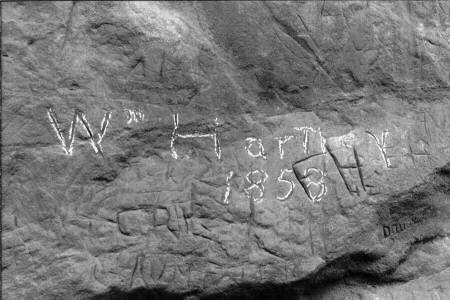
On the south side of Signature Rock, a small 15'x20' rock just to the southeast of North Gateway Rock. Below the name is the date 1858. The name is in the center of the rock, several inches to the left of the A.C. Wright name.
Condition of Name
The name is still legible. The "H," the "t" and the "e" are double-lined, as is the date "1858." Some later initials "F.H." have been inscribed across part of the name and date.
Biography of William Hartley
In the spring of 1858 William Hartley, a civil engineer and surveyor, was among the thirty-five unmarried men who joined the gold seeking party organized by John Easter in Lawrence, Kansas. The party from Lawrence traveled west along the Santa Fe Trail, arriving at the Garden of the Gods on July 8 and remaining there until 10 August.
Hartley was still with the Lawrence Party during the move north to the Russell Diggings at the mouth of Cherry Creek in September of 1858. Over the next several months he became a leader in establishing town sites to accommodate the expected rush of gold seekers the following spring. His friend T.C. Dickson described the activity:
"Shortly after this a party of us, including William Hartley, who was a surveyor and had his instruments with him, decided to lay out a town on the east side of the Platte River, about five miles from the mouth of Cherry Creek, which we did, and called it 'Montana.' About a week after this Chas. Nichols, Adnah French, John A. Churchill, Frank M. Cobb, William Hartley, W.M. Smith, William McGaa, John S. Smith and myself, nine persons in all, who were interested in the Montana townsite, came to the conclusion that we had made a mistake in laying out a town five miles away from the regular trail...So we went down to the mouth of Cherry Creek, surveyed and laid out the town of St. Charles, consisting of 640 acres lying east of th Platte river and Cherry Creek. This was on the 24th of September, 1858.”
After laying out the town of St. Charles, the town company - which included William Hartley - decided to winter over in Lawrence and return the following spring. While they were gone the town site was jumped by a group from Leavenworth, known as the Larimer Party. The area was re-surveyed and re-named Denver City.
William Hartley and T.C Dickson arrived back in Lawrence on 9 November 1858. Nine days later he wrote a statement about the gold diggings at Cherry Creek, and had it published in the Lawrence Republican of 25 November 1858. Sometime after their return to Lawrence Hartley and Dickson collaborated on a guidebook to the new gold fields. It was advertised in the Missouri Democrat of 13 December 1858 as "A descriptive guide book with tables showing camping places, distance between the same, on the various routes, with a comprehensive and reliable map of the newly discovered gold regions." This was among the first of many guidebooks written for sale to the Fifty-Niners. A copy of it could be obtained by mailing one dollar to William Hartley and Company, St Louis, Missouri.
There is no evidence to suggest that William Hartley ever returned to the Front Range of the Rockies.
Sources;
1- T.C. Dickson, The Trail, Vol.III, No.10, March, 1911.
2- Lawrence Republican, 25 November, 1858.
Augustus Voorhees
Location of Name
On the walls of Spaulding's Cavern inside North Gateway Rock.
Condition of Name
The name was still clearly visible when the cavern was re-discovered in 1935. Nearby was the date 1858.
Biography of Augustus Voorhees
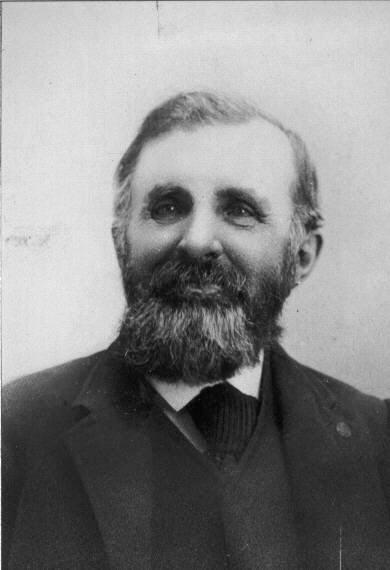
Augustus Voorhees was of German-Dutch ancestry. He was born in New York state on 14 December 1828. He moved to Wisconsin when he was eighteen and to Kansas Territory when he was twenty-eight. In Kansas he farmed and did some coal mining. He was working at the Coal Bank, nine miles northeast of Burlingame, K.T., when he heard that the Lawrence Party had started for Pikes Peak in late May of 1858. He raced thirty-five miles on foot to overtake the train, finally catching the ten wagons at Bluff Creek.
Voorhees was the only member of the Lawrence Party to keep a daily diary. He wrote the diary on sheets of paper, 8"x10" in size. His entries began on 31 May 1858 and continued until 12 July 1858, the date when the gold seekers moved to Jimmy Camp from the Garden of the Gods and there met the returning Cherokees. On that date his diary came to an abrupt end. It is not known if he kept any further records of the trip.
While encamped in the Garden of the Gods during the summer of 1858, Voorhees and two others climbed to the top of Pikes Peak. Of this climb Voorhees wrote in his diary:
"(July)8 Miller cooked four days provisions to go to Pikes Peak.
"(July)9 We started in the morning, followed up the creek valley three miles, and found three soda fountains or boilling fountains. They are quite sour and resemble Congress water. They boill up very strong. We also found a log shanty there. We climbed the mountain all day, found some hard climbing and large rocks. I killed one sage hen which we roasted for supper. We made our camp between two rocks and built a large fire. We had a light shower in the night. They had a heavy hail storm at the camp. We crept under some rocks.
"(July)10 Started early and went to the foot of the main peak and left our blankets, and went on up. We had a heavy hail storm, which kept us three hours under a rock. The mountain was covered with hail. We got to the top at three o'clock, but it was so cloudy we could not see the country beyond. We cut our names on a stick and p(ut) it in a pyramid of stone that we piled up. The top is levle twenty-five or thirty acres, nothing but small rock tumbled together. We started down at four o'clock, it was so cloudy that we could see nothing below us. We could not find the way to our packs, and we stoped at the first timber which was pick pine, and found a rock to shelter us from the wind and the rain. We built a great fire and stoped for the night. It was so cold we did not sleep much without our blankets. We were one mile from the top. It blew very hard all night.
"(July)11 The fog blew off this morning so that we could find our packs, and we started for home. The mountains are covered with spruice, the fire has burnt the most of them dead. The red raspberey and strawbereys are quite thick. Some of them are ripe and some are in blossom. The fog was so thick that we could not see much as we came down. We found some quarts rock and some creystal quarts. We came into camp at four o'clock."
Voorhees stayed with the Lawrence Party during the trip south to the old Spanish Diggings in Grayback Gulch, then north to the new diggings on Cherry Creek. In the fall of 1858 he returned to Kansas with other members of the Lawrence Party. When the Civil War broke out he enlisted in the Fifth Kansas Cavalry. He served for three years. Later he moved back to Wisconsin, then - in 1890 - returned to Kansas. Despite all this moving around, he found time to get married and rear a family of seven. Augustus Voorhees died in Kansas in 1905.
Sources:
1- Augustus Voorhees "Diary." Original in possession of the State Historical Society of Colorado.
2- Biographical Sketch in Pike's Peak Gold Rush Guidebooks of 1859, edited by LeRoy R. Hafen.
I. L. Avery
Location of Name
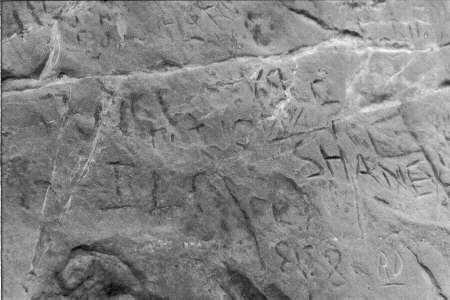
On the northeast end of North Gateway Rock.
Condition of Name
The letter cavities are darkened by a form of lichen. The middle three letters of the name Avery are not very clear; the other letters and numbers seem certain. Both name and date appear more legible at a distance of a few yards. Of special interest is the word Iowa, which appears up and to the right of the name.
Biography of I. L. Avery
A gold seeker named Avery was with one of the early parties, which left the Missouri River when reports of the gold finds at Cherry Creek began to reach the Midwest in the early fall of 1858. The Crescent City, Iowa, Oracle of 24 September 1858 carried an article on just such a party:
"Our place has been for ten days in a state of excitement, caused by the news from the west, and preparation for emigrating to the new El Dorado.
"Yesterday C..H. Blake and A.J. Williams, Esqs, two of our most energetic and prominent citizens, with four well laden wagons and 14 yoke of cattle and two ponies, started for 'South Platte,' with merchandise to trade with the diggers and mountaineers.
"From this place also went in same company, Messrs. McGlashea, Avery, Willoughby, Gordon, Clark, Conant, and others."
Blake and Williams set up one of the first stores on the banks of Cherry Creek; in the spring of 1859 they built the Denver House, the first large hotel in the area. As for Avery, he may have left his name in the Garden of the Gods on his way to winter over in Fountain City, the present Pueblo area, as did perhaps as many as 200 of the gold seekers who stayed during the winter of 1858-59.
Fred Kocherhans
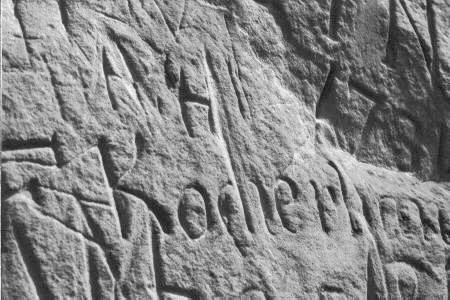
Location of Name
Just above and to the right of Ketner's Cave on the west side of White Rock.
Condition of Name
The name is carved very deeply into the rock. Beneath the name is a year which, at first glance, appears to be "1785;" closer observation, however, reveals only a few scratchings and the date "85," none of which seem to belong to the Kocherhans name.
Biography of Fred Kocherhans
Fred Kocherhans seems to have been a boot maker by profession. He left Plattsmouth, Kansas Territory on 20 September 1858 for the Cherry Creek diggings. With him was a wagon train of six wagons and nineteen men known as the Plattsmouth Company. They were joined at Fort Kearny by another twenty-six men and their nine wagons from Kansas and Missouri.
The combined party of forty-five men reached the mouth of Cherry Creek on 24 October 1858. Five days later, many of them were involved in the organization of the Auraria Town Company, and in the subsequent construction of log cabins on the west side of Cherry Creek.
Fred Kocherhans seems to have spent the winter of 1858-59 hunting and prospecting. In company with Anselm Barker and William Liston he traveled the Front Range, from Boulder Creek in the north to the head of Cherry Creek on the Platte-Arkansas Divide. The men later took credit for naming many of the streams: Clear Creek for its clear water, Ralston Creek because a man by that name had found gold there, Rock Creek for its many rocks, Boulder Creek for its boulders, Left Hand Creek because they found the Indian Left Hand camped there.
Fred Kocherhans seems to have supplemented any income he may have gained from the diggings by working at his trade of boot making. On 7 May 1859 he sold a pair of boots of his own manufacture to Anselm Barker for $7. Whether Kocherhans ever opened his own boot shop is not known. What is known is that he farmed for a time at the mouth of Cherry Creek, in present downtown Denver. There he was listed as a settler in the summer of 1859.
Kocherhans soon disappeared from Colorado history, and was forgotten. His name was misspelled as "Kockerhans" as early as 1859 in Anselm Barker's diary. By the time of the first annual reunion of the Society of Colorado Pioneers on 25 January 1881, the Kocherhans name was entirely unrecognizable. He was listed by keynote speaker, Professor F.J. Stanton, as "member of the Plattsmouth Company, Fred Kucherhautz." Only in the Garden does the name remain as the man himself spelled it.
Sources:
1- Barker Diary. edited by Nolie Mumey. Golden Bell Press, Denver, 1959.
2- "The Founders of Denver and their Doings," The Trail Vol. XIV, No. 12, May 1922.
Marshall M. Jewett
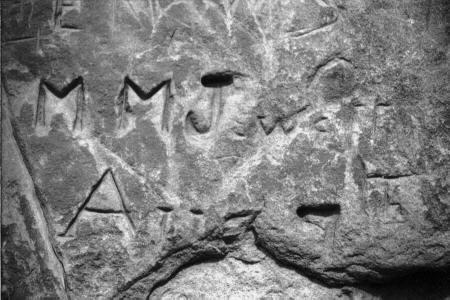
Location of Name
The name is below and to the left of the Perkins' Plaque on the south end of North Gateway Rock.
Condition of Name
The letters "M.M.J" are cut very deeply into the rock; the remaining letters "ewett" are lightly cut, and are readable only under close inspection. Very likely, a year was originally inscribed below the date "Aug 7th," but if so it has long since disappeared due to chipping of the rock.
Biography
Marshall M. Jewett was a member of the well-equipped Larimer Party of gold seekers which was organized at Leavenworth, Kansas Territory, in September of 1858. The Larimer Party left for the goldfields at Cherry Creek on the first day of October with eight wagons, six months' supply of provisions, and thirty-two men.
General Larimer and his men reached the Rocky Mountains on 16 November 1858. Almost immediately they began surveying the land east of the mouth of Cherry Creek. In so doing, they were actually jumping the town site of St. Charles, which had been but recently established by William Hartley and other members of the Lawrence Party. Nevertheless, on 22 November, General Larimer and some associates formed the Denver City Town Company and adopted a constitution. Their town was named in honor of James W. Denver, who had been governor of Kansas when they left Leavenworth, but who - by late November - had already left office.
Marshall M. Jewett wrote at least one letter home to Leavenworth from his camp on Cherry Creek. The letter, dated 18 November 1858, was published in the 25 December issue of the Leavenworth Times:
"We arrived here on the evening of the 16, after a very pleasant journey. This place is situated on the junction of the Platte and Cherry Creek, and about 12 miles from the mountains. I went up to Montana, a place of about 30 log houses, six miles above here, on the Platte. Found Buell and company - also most of the Lawrence boys. Whitsett and I are going to build at Montana...It is estimated that there are almost six hundred men within fifteen miles of this place, scattered along the river."
Marshall M. Jewett seems also to have been an original member of the Colorado City Town Company, which was organized the following year. He was very likely one of the dozen men present when the idea of founding a town near the Garden of the Gods was first put down on paper. The site of this meeting was the office of Richard Whitsitt on Larimer Street in Denver City. The date was 11 August 1859.
Before long Jewett seems to have had some second thoughts about the value of his interest in the Colorado City Town Company. In late February of 1860 he sold one half of his interest to Joseph M. McCubbin for $150, cash or merchandise. This contract was first registered at Leavenworth, later filed in Colorado City with town recorder, M.S. Beach. On 13 July 1860 Jewett sold the other half of his original interest to the same McCubbin for an extra $400.
But Jewett did not abandon all connection with the town so near the Garden of the Gods. On 26 April 1860 he entered into contract with John Gerrish and E. Cobb to purchase their original interest in Colorado City for $425. Gerrish and Cobb were in the process of selling their grocery business to the Tappan brothers, and were obviously looking to unload their Colorado City interest at the same time. The transaction worked out to Jewett's benefit as well. In less than six months time he had sold his original interest for $550 and bought another for $425, thus realizing a profit of $125.
Marshall M. Jewett seems to have moved back to Leavenworth sometime in the early 1860's and to have severed all ties with the town of Colorado City. Only his name in the Garden of the Gods still serves to mark his early presence in the Pikes Peak gold fields.
Source: El Paso Claim Club Record Book, copy at the Colorado College Library.
D.P. Drake
Location of Name
On the walls of Spaulding's Cavern inside North Gateway Rock.
Condition of Name
According to the reporter who entered the cavern when it was re-opened for a time in 1935, the name "D P Drake" appeared plainly on the cavern walls.
Biography of D.P. Drake
In mid-October of 1860 there was a D. Drake living on South Clear Creek in the mountains west of Denver City. He was a teamster from Missouri, 32 years of age. Residing with him were two other teamsters: C. Miller and E. Wiggins.
W. Nelson, 1866
Location of Name
On the walls of Spaulding's Cavern inside North Gateway Rock. There is also a W. Nelson on the eastside of White Rock. The name is just up and to the right of the O. Brooks name.
Condition of Name
According to the reporter who entered the cavern when it was re-opened for a time in 1935, the name W. Nelson,1866 appeared plainly on the cavern walls. The name on White Rock is not carved as neatly as some of the other names. The "s" is somewhat faded.
Biography of W. Nelson
There was a W. Nelson mining along the South Platte river in early November of 1860. He was 34 years of age and a native of Illinois. He had three other miners as companions: one, like himself, was from Illinois; the other two were from Ohio.
D.W. Mills, 1866
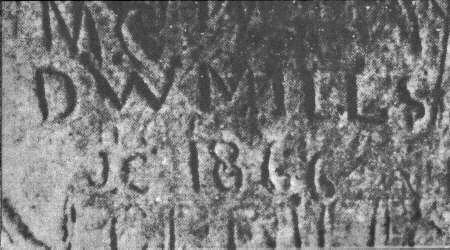
Location of Name
On the walls of Spaulding's Cavern inside North Gateway Rock. There is also a "Mills, 1866" on the southeast side of North Gateway Rock. The name is below and just to the left of the "E.S. Imes" name. This Mills name is one of only two historic names in the Garden that were carved into the sandstone not once, but twice. The other name is that of W. Nelson, 1866."
Condition of Name
The exterior Mills name is still legible; only the "8" in the date has worn away. The area to the left of the name, where one would normally expect to find distinguishing initials, seems to be a water trough when the rains come, and is consequently swept clean of carvings. The name inside the cavern is written "D.W. Mills" and is followed by the date "1866." When the entrance to the cavern was re-discovered in 1935, a photographer for the Gazette and Telegraph took a picture of this name. The letters seem to have been carved after the same fashion as those of the Mills name on the southeast side of North Gateway There was a D.W. Mills listed in the El Paso County 1867 Tax Schedule.
William A. Lierd
Location of Name
On the walls of Spaulding's Cavern inside North Gateway Rock.
Condition of Name
According to the reporter who entered the cavern when it was re-opened for a time in 1935, the name "W. Lierd '70" appeared plainly on the cavern walls.
Biography of William A. Lierd
William A Lierd was born October 30, 1846 in Burlington, Iowa. Both of his parents had come from Ireland, met and married and raised their family of three in Burlington.
Lierd first came to E1 Paso County in August of 1870. He came from Chicago. He lived for many years in Monument where he kept a grocery store.
On March 31, 1891, he traveled to Lee's Summit, Missouri, and married Emma B. Laythe. The couple raised three children: Lela, Clifton, and Hallie Winnifred.
In later years, William and Emma moved to Colorado Springs and settled in at 722 N. Weber Street. Both were members of the E1 Paso County Pioneer Society.
Source: Kerr's Pioneer Questionnaires, C.S. Pioneers' Museum.
Louisa B. Frost
 .
.
Location of Name:
On the walls of Spaulding's Cavern inside North Gateway Rock.
Condition of Name:
The picture taken by the Colorado Springs Gazette and Telegraph photographer in 1935 showed the name Mrs. Lou Frost to be entirely legible.
Louisa was born in 1846 in Missouri. When she was nineteen years old her parents decided on a move to Colorado Territory. On 7 April 1865 they crossed the Missouri River at St. Joseph. On the other side of the river they organized with one hundred other wagons into a train under the command of Captain Cross.
Other members of the wagon train included a Jack Morris, his wife and mother; a Methodist minister by the name of Johnson, his wife and niece and two orphaned nephews; two bachelors; a maiden lady and her mother and a young man driving their wagon; a Dr. Massey and his family; a young man named Jeff Compton, who was Louisa's beau during the trip. Several of these emigrants figured in the sham wedding planned by Louisa and one of her friends:
"One evening, we wanted a little fun in camp. We asked one of the bachelors and our maiden lady, Miss Nancy Matthews, to get married - just for fun. So they said they would. My chum and I went to the preacher and let him in on the secret. He was to say only what was necessary to carry out the effect, not the real service, to make them man and wife. After it was over we told them that they were really married because Mr. Johnson was really a minister. The old bachelor was furious but our maiden lady was pleased. We had a lot of fun with them but finally made it all right with the old bachelor by assuring him he wasn't married."
The year 1865 was a time of serious Indian uprisings all along the trails leading into Colorado Territory. Almost all the stage stations and road ranches along the Platte River had already been burned by marauding Indians. Louisa's wagon train did not make it through without the usual alarms. In later years, Louisa recalled one of those incidents:
"After strenuous traveling for several days the captain told us we could stop and rest for a day or so. We went down to the river to do some washing. Just as we had the clothes well soaked with water, we were told to pack everything at once and come back to camp as some Indians were there and acting very strange...There were about 50 mounted warriors, gaudy in paint and feathers. Some wore buckskin but most of them were almost nude. They watched us silently for quite a while.
"Our men were all on guard and well armed so they didn't try anything...The captain figured they might be intending to bring more men later on for an attack, consequently when the Indians were well out of sight, he ordered to pack up and cross the river for a better position....
"Guards listened to every movement on the prairie that night. If the Indians were coming back it was expected at dawn as that was the favorite time for them to attack. So long before daylight, our camp was up. But we were not molested that time or any other time, and made it to Colorado without getting scalped."
On reaching Colorado Louisa settled with her parents in Fort Collins. From there her father moved the family to East Cherry Creek in Black Forest. By 1870 Louisa was married to Edward W. Frost, a former government scout, Indian fighter and veteran of the Civil War. In the census of 1870 Louisa and her husband were listed as living at Virginia in El Paso County. (Virginia had ten houses in 1870. The name was changed to Frost's Ranch in 1871, to Rock Ridge in 1872, and finally discontinued in 1892). Edward was twenty-four years old, according to the census taker of 1870. Louisa was one year his junior, and keeping house for her husband, her brother Amos, and three other hired men. Louisa and Edward had one child, Edward Jr., then one year old.
The Frost family later moved to Colorado Springs, where they raised a family of three sons. Edward became a city alderman, water commissioner and health commissioner. He died in 1914 at the age of seventy-nine. Louisa survived him for twenty-two years. When her name was discovered inside Spaulding's Cavern in 1935, she was the oldest member of the El Paso County Pioneer Society. She died the following year.
Sources:
1- "Interview with Louisa Frost," Colorado Springs Gazette and Telegraph, 3 November 1935.
2- Colorado Territorial Census of 1870.
3- "Obituary of Edward W. Frost," The Trail, November 1914.
4- "Obituary of Louisa B. Frost," The Trail, 29 November 1936.
William Henry Jackson
Location of Name:
On the walls of Spaulding's Cavern inside North Gateway Rock.
Condition of Name:
The "W.H. Jackson, 1870" name was just barely legible when photographed by a Gazette and Telegraph reporter in 1935. The reporter was trying to photograph the "Mrs. Lou Frost" name and inadvertently also photographed the "W.H. Jackson" name just below.
Biography of William Henry Jackson:
William Henry Jackson was born at Keeseville, New York, on 4 April 1843. His father was born a farmer, but later took up blacksmithing and carriage making. His mother was a city-bred girl, an artist who used both pen and brush.. From her young William learned how to draw. At the age of 15, he was doing retouching in a photographer’s studio in Troy, New York. Two years later, he took a job in Rutland, Vermont, as a photographer’s helper.
During the Civil War, William Jackson enlisted in the 12th Vermont Volunteers. He was in service during the battle of Gettysburg, not on the fighting front, but rather behind the lines guarding baggage. Afterwards, he helped escort 2,300 Confederate prisoners to Baltimore.
After his enlistment ran out, Jackson returned to Vermont. There he worked in Styles’ Gallery in Burlington, tinting enlarged photographs of military men. A failed love affair in 1866 turned his attention to the west. With an old Civil War buddy named Ruel Rounds he traveled the Oregon and California trails from St. Joseph to the west coast, making many sketches along the way.
On his return from California, Jackson set up a photography shop in Omaha with his two brothers. A sign above the door read: “Jackson Brothers, Photographers." Soon after he was married to Mollie Greer, who had recently moved west from Ohio.
On 23 July 1870, Professor F.V. Hayden arrived in Omaha seeking a photographer to accompany him on his surveys. Jackson fit the bill perfectly. He was, however, to receive no salary, but merely payment of expenses. No matter. Jackson was soon on the trail west. After reaching Cheyenne, he continued westward toward Fort Bridger, turned southward into the Uintah Mountains, then slowly made his way to the Pikes Peak region – all the while taking photographs of the many scenic wonders. Once his photographs were seen in Washington, D.C., Jackson became a regular and salaried member of Hayden’s staff. Throughout the fall of 1870 Jackson was in Colorado Territory, taking photographs of Pikes Peak and the Garden of the Gods. While there, he seems to have entered Spaulding’s Cavern inside North Gateway Rock and inscribed his name on the cavern walls. The next summer he traveled north to photograph the many wonders of the Yellowstone country.
Personal tragedy struck the Jackson family in February of 1872. William’s young wife Mary and her newborn baby both died during childbirth. He returned to Omaha and sold his photography shop, intending thereafter to devote himself exclusively to the Geological Survey. During the ensuing years he photographed numerous southwestern scenes, including the Mount of the Holy Cross, the Elk Mountains and Mesa Verde.
After nine years of continuous travel, Jackson work with the Geological Survey finally came to an end. Jackson decided to open his own photograph studio in Denver. He also had a home built on Capitol Hill to house his second wife, Emilie, and their three children. During the years 1880-1881 he was busy picturing the scenic wonders along the Denver & Rio Grande Railroad. From time to time he also made special trips to the Pikes Peak region to re-photograph the Garden of the Gods. It is said that between the years 1885-1892, Jackson carried his camera into every corner of the United States, as well as through Canada. In October of 1894 he set out on a world tour with the World’s Transportation Commission, photographing Europe, Africa, India, Australia, Japan and Russia.
In later years, Jackson sold his studio in Denver and moved to Detroit where he became a partner in the Detroit Publishing Company. The company specialized in photographic views and copies of famous oil paintings. The business prospered until 1923, when it went into bankruptcy.
At the time of the bankruptcy, Jackson was 81 years old. His second wife had died five years earlier. His son and two daughters were all already married. He himself was left with a bank account of only $6,000 and a Civil war pension of $75 a month. But somehow he managed to survive for 19 more years. His recipes for longevity was: “Always have something to do tomorrow.”
In 1929, Jackson moved to New York City to become research secretary for the Oregon Trail Memorial Association. He celebrated his 99th birthday at the Explorers Club in April of 1942. He died on 30 June of the same year as a result of a fall in his apartment at the Hotel Lathem.
William Henry Jackson’s photographic legacy is preserved in the collection of western negatives acquired by the State Historical Society of Colorado through the courtesy of the Ford Foundation in Detroit. Also, some 35 of his original Oregon Trail paintings and sketches are on permanent display at the Visitor Center at Scotts Bluff National Monument in Nebraska. His name and the date “1870” still remain hidden inside Spaulding’s Cavern in the Garden of the Gods.
Source: The Diaries of William Henry Jackson, ed. By LeRoy R. Hafen and Ann W. Hafen. Glendale, CA: The Arthur H. Clark Company, 1959.)
©1999-2009 Richard Gehling
E-mail me at GehlingR@q.com
